


St. Georgen in the Attergau
2017/11/07
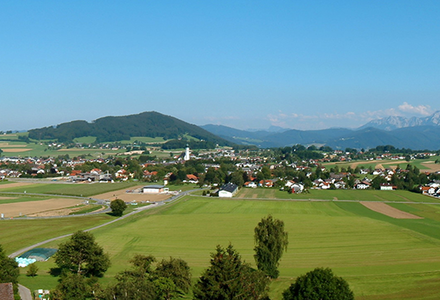


A wealth of history, culture and nature
Of Celts, Romans and Dukes
St. Georgen im Attergau lies near Lake Attersee in the Hausruckviertel region of Upper Austria. People began settling here very early on. Excavations have uncovered Celtic settlements dating back to the Bronze Age (4th century BC). These settlements were part of the Celtic kingdom of Noricum. The Celts of St. Georgen traded goods with Hallstatt and buried their dead in burial mounds. Today, the Celtic Tree Trail provides an insight into the way of life of the Celts over 2,000 years ago. After the Celts, the Romans arrived in the region. In 15 BC, they conquered Noricum and incorporated the Attergau into the Roman Empire. They were to rule over this land until 488.
The Roman occupation led to peaceful coexistence between Romans and Celts. The cultures intermingled, and agriculture and infrastructure experienced an enormous boom. Following incursions by the Germanic tribes and the Huns, the Romans withdrew and the Bavarians took command. They cleared large areas of land and established villages. The area was also divided into districts, and the name Attergau first appeared (in 790 AD). St. Georgen emerged from the village of Attergau after a church dedicated to St George was built there. Bavarian dukes ruled the region and later made it a judicial seat. In 1463, St. Georgen was granted market town status and in 1490 it fell under the rule of the Principality of Austria above the Enns. In 1848, the peasants were freed from serfdom and became free citizens. Since 1918, the town has belonged to the province of Upper Austria and since 2002 to the Salzkammergut tourist region.
The 1,000-year-old lime tree
The 1,000-year-old lime tree is a landmark of St. Georgen im Attergau. It is a protected tree and, until the 16th century, was a place where judgement was passed on matters of right and wrong. It is also known as the 1,000-year-old lime tree in Gries and was planted in 1114 – the same year the church tower was built. It is approximately 30 metres tall and, with an incredible circumference of 29 metres, is almost as wide as it is tall.
Culture and nature
Worth seeing in this village of just under 4,500 inhabitants is the 14th-century parish church, featuring elements from the Guggenbichler workshop. The Kogl Castle ruins on the Koglberg date back to 1264 and were abandoned in 1524. Kogl Castle, on the other hand, still stands majestically in its original location at the foot of the Koglberg. It was completed in 1441 and has been rebuilt several times. A highlight for tourists is the Celtic Tree Trail. Whilst hiking on the Koglberg, you can rediscover the life of the Celts along a 2.5 km or 5 km route. There are also two museums. The Aignerhaus sheds light on rural and artisanal life from the past, whilst the Haus der Kultur hosts various exhibitions. The surrounding natural landscape is particularly worth seeing. St. Georgen lies in the heart of the Salzkammergut and is ideal for excursions and hiking trips to the nearby lakes such as Attersee, Mondsee or Traunsee, and to the nearby Alpine peaks.
written by Christian Messmer